Unordered List

Saturday, 5 April 2014

Captain America: The Winter Soldier, Part 2 -- HYDRA, Sitwell, and diversity in the Marvel universe

Previously: Part 1: "Trust No One" -- Steve Rogers as the ~gritty superhero America deserves.

When it came to using HYDRA as the antagonist once again, Winter Soldier's writers were caught between a rock and a hard place. At face value, the concept of an evil organization infiltrating SHIELD is perfect for the Winter Soldier storyline ("You shaped the century.") and can be linked in with real-world concerns about PRISM and drone strikes.

Unfortunately, the filmmakers couldn't really create a new, more plausible evil conspiracy when they already had HYDRA ready and waiting in the sidelines of the Captain America mythos. This meant they then had to try and legitimize a scenario where thousands of SHIELD agents decided to join a blatantly evil secret society with roots in a Nazi cult, without ever being detected. And, in many cases, without a clear-cut explanation for why they joined in the first place.


With a villain as wide-ranging as HYDRA, they had to give us a few entry characters to illustrate different aspects of the organization. Zola represented the cartoonishly evil Nazi backstory, while Alexander Pierce had a more pragmatic explanation for why he believed in HYDRA's goals. The weakest point was Agent Sitwell. Introduced as the "human" side of HYDRA, he was the evil equivalent of Coulson's benevolent middle-manager schtick in Avengers.

Friday, 4 April 2014

Captain America: The Winter Soldier, Part 1 -- Trust No One.

Previously: The costumes and characters of The Avengers -- Captain America.


I've been enjoying the number of reviewers who smugly namechecked Edward Snowden while writing about this movie, but they do have a point. Captain America: The Winter Soldier is about as "realistic" as you're going to get in the superhero genre, in a way that I found far more satisfying than the stereotypical ~gritty reboot~ atmosphere of the Dark Knight trilogy.

Whether or not you're a fan of Nolan's Batman movies, I think it's fair to say they were masterminded by someone who doesn't have much affection for the superhero genre -- which is funny when you consider the overt silliness of The Dark Knight Rises. CATWS provided an excellent balance between a relatively realistic concept (SHIELD's PRISM-inspired surveillance helicarriers), and the inherently optimistic nature of Captain America as a character.
Steve Rogers may do a lot of punching in this movie (perhaps too much punching, dare I even say it), but his true superpower is his status as a role model and leader. In the end, it's Steve who decides that SHIELD is beyond salvation, Steve who inspires Falcon to join the fight, and Steve who persuades SHIELD agents to ignore direct orders because it's the right thing to do.

He's the guy with the guts to go first when confronting everyone from schoolyard bullies to his own superior officers, and you can really understand why people rally behind him as a figurehead. He doesn't have the firepower of Thor or Iron Man or the political sway of Nick Fury, but he's the one trustworthy rock in the shifting moral sands of SHIELD and HYDRA.

Pre-Winter Soldier Marvel article roundup

I saw Captain America: The Winter Soldier last week, but have been holding off on posting a review until it's out in the US. That hideously long review will be up either tonight or tomorrow, but until then, here are some Marvel superhero articles I've recently written elsewhere!

Wolverine Fatigue -- Has Wolverine outstayed his welcome at the head of the X-Men franchise? (Hint: the answer is yes. Please hand the reins of this political oppression allegory over to someone who isn't a white hetero dude.)

Captain America as a modern-day hero of equal rights -- One of the reasons why I'm so fond of Cap fanfic, TBH.

Chris Evans and the gilded cage of Marvel movie contracts -- Chris Evans has said on multiple occasions that he wants to step away from acting, but is locked into a six-movie contract with Marvel. This article is a look at the various Marvel actors who have signed up for a decade of superhero movies, and may now be regretting it.

Why do film critics still think Black Widow is an eye candy role? -- I took a look at the reviews from film critics in well-respected newspapers and magazines, both for Avengers in 2012 and the earlier UK reviews for CATWS. A depressing number of of (male) reviewers described Black Widow almost exclusively in terms of her looks, even in CATWS, where she has second billing to Captain America. Bear in mind that Cap's outfits are just as tight and "sexy" as hers, and that Thor, Cap and Bucky have all now had relatively gratuitous shirtless scenes in each of their movies, probably putting them ahead of Black Widow in the eye candy stakes. It's really quite incredible how many professional film critics failed to comprehend Black Widow's true role in these movies, but instead interpreted her as a pouting, "leather-clad" badass -- a hilariously inaccurate summation of a woman who is specifically characterized as the most cerebral Avenger (i.e. beating Loki at his own game), and doesn't even wear a leather costume.

OK, that's all for now. If you haven't seen CATWS yet, here's my non-spoilery advice for what to look out for when you see it for the first time. If you've seen it already, check back later for my review, which will be approximately the same length as the Encyclopedia Britannica. My other Marvel movie reviews, including costume design analysis, can all be found on my Marvel tag.

Tuesday, 1 April 2014

Costuming and design in Hannibal: Bella Crawford, between life and death.

Previously: Costuming and design in Hannibal, Part 1, Part 2, and Part 3 (Hannibal's wrist watch.), Part 4 (Abigail Hobbs).

I already mentioned in my first Hannibal costuming post that the FBI team dress like characters in a crime procedural drama, while people like Hannibal and Bedelia du Maurier seem to come from another universe entirely. The main visual difference between the FBI lab team and your average CSI character is that they wear vanishingly few monochrome outfits.
Compared to a show like Person of Interest, where two or three main characters can be wearing all-black outfits in any one episode, Hannibal's crime-fighters look positively colourful. Beverley Katz has at least three different maroon jackets, Jack Crawford loves his dark blue and purple jewel tones, and even Price and Zeller mostly wear neutral colours like navy blue or beige. (Price is characterized by his slouchy dad outfits and cardigans, while Zeller's clothes are more youthful and flattering.)
The only character in the show who habitually wears black and white is Bella Crawford. In her first appearance in "Coquilles," she's wearing a pure white dress to a dinner party with Hannibal and her husband. In the darkness of Hannibal's dining room, she stands out immediately, and the draped style of the dress makes Gina Torres look like some kind of ancient Greek deity.

Sunday, 23 March 2014

Costuming and design in NBC's Hannibal: Abigail Hobbs

Previously: Costuming and design in Hannibal, Part 1, Part 2, and Part 3 (Hannibal's wrist watch.)

While Hannibal Lecter's suits are undoubtedly the most eyecatching costumes on the show, I found myself really warming to Abigail's costuming when rewatching season 1. Her clothes in "Potage" are particularly interesting, because they were bought for her by Alana Bloom. This means that rather than wearing her own clothes, she's actually dressed in Alana's interpretation of Abigail-clothes.

Abigail may be an emotionally fragile 17/18-year-old girl, but I'm glad to say that she's neither dressed up like a TV teen (which wouldn't remotely fit in with the overall tone of Hannibal), or styled to look more childlike and therefore ~vulnerable. Like the adult characters, she has a very specific dress sense and colour palette, which in her case is very "outdoorsy". Either she's wearing sensible hunting clothes to spend time in the forest with her father, or she's dressed in green and brown, often surrounded by natural imagery of plants and flowers. While Hannibal is a Francis Bacon painting and Will is an Edward Hopper, I think Abigail is a botanical illustration.
Screencaps via screencapped.net
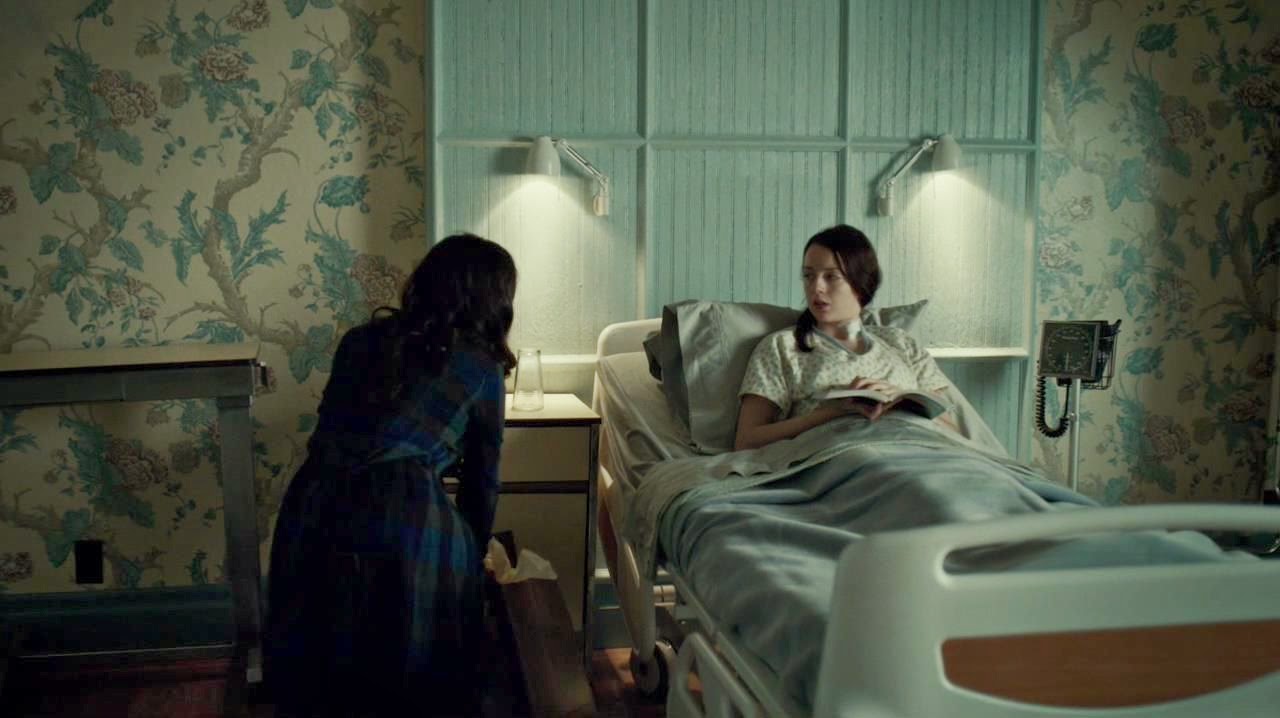
Abigail's hospital room is very serene, with her butterfly-patterned nightdress matching the pale blue-green bed linen, furniture and patterned wallpaper. This delicate floral motif is directly at odds with Freddie Lounds, who shows up wearing a leopard print dress, a red-lined cape and gloves. Freddie looks practically Disney villainesque in her predatory role as Abigail's unwelcome visitor, and is the one central character in the episode who isn't wearing an outfit that fits in with Abigail's colour palette.

Wednesday, 19 March 2014

Costuming & design in NBC's Hannibal: Hannibal Lecter's wristwatch.

As part of my ongoing series on costume and design in Hannibal, I'm going to post my first guest blog with contributions from an outside writer. My brother is a watchmaker and an avid fan of Hannibal, and recently mentioned to me that he had some thoughts on Hannibal's watch in the show (a $176,300 white gold Patek Phillippe 5270G Chronograph, apparently). Here's what he had to say:
via weartherude
Patek Phillippe are generally seen by most watch people as the big brand leaders. They have an extremely prestigious rep, although reputation is very, very weird with watches. It doesn't just vary by brand but also by model. The Rolex worn by a particular James Bond in a particular Bond movie may be seen as some amazing piece of art, but a gold-cased Rolex of the same model but a different year could be trash. To give you an idea of Patek Phillippe's marketing brand, here's a recent advert:

Tuesday, 18 March 2014

Costumes and design in NBC's Hannibal, Part 2.

Previously: Part 1

Rewatching the first few episodes so close together, I quickly began to notice the many instances where characters are wearing colours that either match or complement each other. Part of the reason I picked up on this is because the transition between the pilot ("Aperitif") and second episode ("Amuse-Bouche") is so noticeable.

In "Aperitif" there's still no overarching colour scheme linking the cast together, but as soon as Hannibal switches from his normal-person disguise of beige and brown sweaters to his own "real" clothing in episode two, everything begins to come together. After this, there are moments in every episode where certain characters are seen wearing complementary outfits or somehow fit in with the colour scheme of their surroundings. This is surely no accident, either as an aesthetic choice or as one of the many moments of visual symbolism in the show.
Before we move onto the rest of the season, I'd just like to spend a moment on Hannibal's uncharacteristically bland outfits in "Aperitif." Someone else has already written about Franklyn's habit of "mirroring" Hannibal's dress sense so I won't go into too much detail here, but as Hannibal's most obsessive patient, it's possible to theorise that Franklyn is attempting to copy Hannibal's style. There are several scenes throughout the series where we see Franklyn wearing layered outfits and "loud" ties that seem like a pale simulacrum of Hannibal's costumes, but in the instance of "Aperitif," I think the reverse may be true: Hannibal is mirroring Franklyn.
Screencaps from screencapped.net

Tuesday, 11 March 2014

Costumes and design in NBC's Hannibal, Part 1.

I probably should've been writing about the costumes of Hannibal from the very start, but I confess to feeling a little overwhelmed. The quality of the costume design (and set design, and food design, and soundtrack...) in Hannibal is so incredible that not only does every episode deserve its own post, but lots of other people have already been analysing it since day one. Is there even room for another reviewer? But as luck would have it, I just moved in with someone who has never seen the show, and we decided to watch season 1 from the beginning. I can now verify that it's one of those rare TV shows whose rich detail means that it actually improves when you watch it for a second time.
In "Aperitif," Hannibal's costumes are far more varied than in later episodes, mostly because he's wearing a kind of everyday camouflage half the time. A more literal version of what Bedelia du Maurier refers to as his "people suit," if you will.

At home and in his own office, we see Hannibal in his typical uniform of luxurious three-piece suits. But whenever he has to go to the FBI, he wears what basically amounts to normal-person drag: a scruffy blazer, brown sweater, and unbuttoned shirt. The colours complement each other, but it isn't the kind of daring fashion choice we see him making in most other scenarios. I suspect this was him testing the waters at the FBI, attempting to fade into the background until he's scoped things out. Hannibal doesn't actually make much effort to disguise his eccentricities in day-to-day life, but he does ease people into them. That's how he gets away with making so many cannibalism puns during his dinner parties, I suppose. But while Hannibal's uncharacteristically scruffy FBI outfit was something I noticed when I first watched this episode, the moment that I found most visually arresting this time round was his first appearance onscreen.
The first thing we see from Hannibal Lecter is his hands, cutting into some meat as he eats alone in the dark of his house. Virtually all reviews of Hannibal comment on the way the show concentrates on the journey rather than the inevitable outcome of Hannibal's arrest and incarceration. We know that Hannibal is a cannibal, and the writers know that we know. There's very little suspense in that regard. So the show can cheerful jump-cut from Will Graham saying, face twisted into a grimace, "He's eating them!" to a lingering shot of Hannibal tucking into his first sumptuous meal of the series. We're all in on the joke, which makes Hannibal's frequent "I'm having an old friend for dinner," puns all the more delicious.