Unordered List

Showing posts with label 1950s. Show all posts

Thursday, 14 February 2013

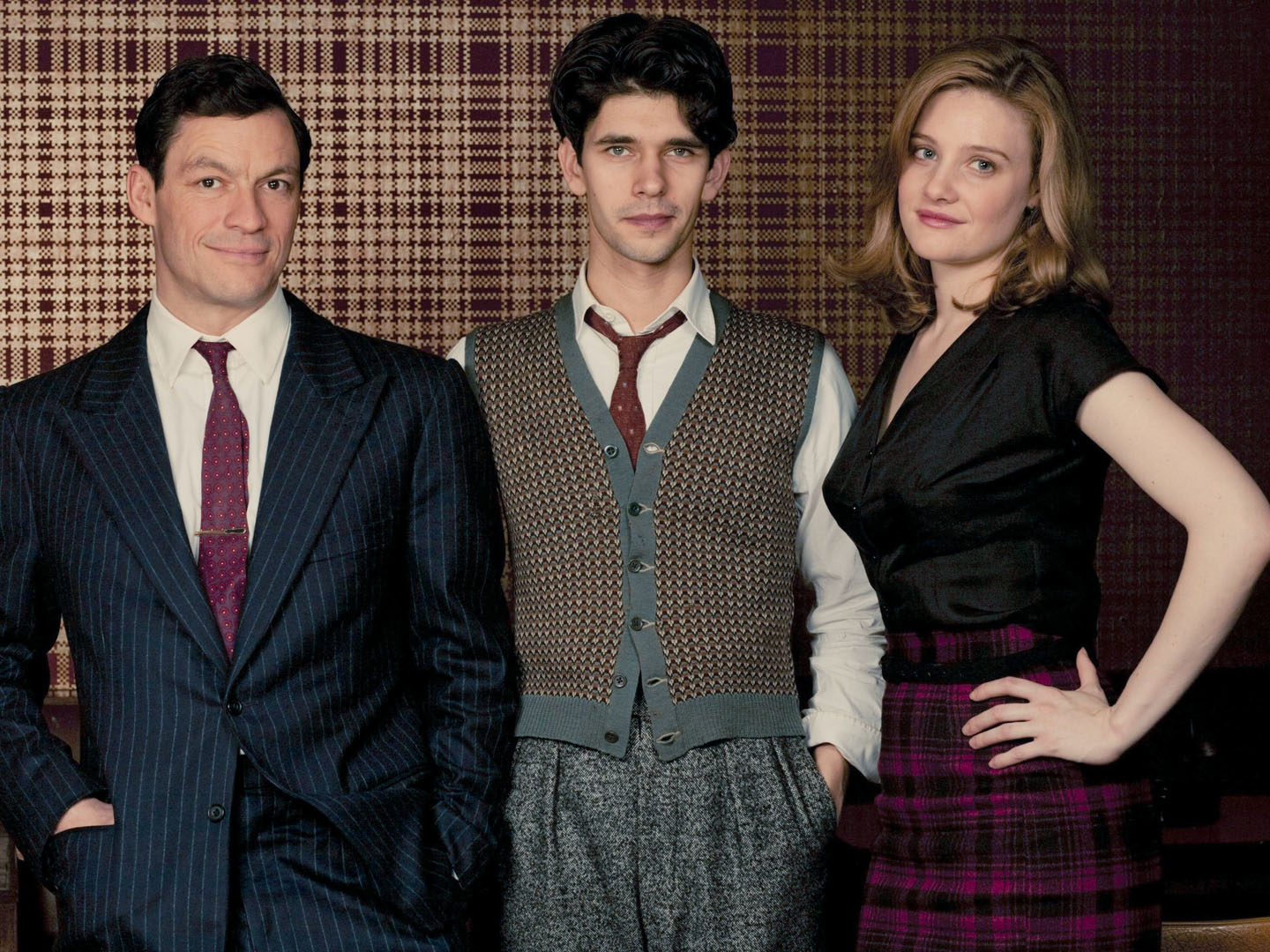
Womenswear and The Hour.

Previously:  Bel Rowley and Freddie Lyon & Menswear and The Hour.

As a kind of doomed swansong for The Hour's recent cancellation, here's the third and final part of my series of costume posts.

Marnie is absolutely the classic stereotype of 1950s womanhood. In season 1 she doesn't get much to do, but by season 2 Hector's terrible behaviour has shaken her up enough that she transforms into what I can only really describe as a 2010s-style ultra-femme liberated woman. Probably my favourite detail of this was the fact that she clearly had an affair at some point, but it was so subtle that we'll never really know who with. With any other character I'd dismiss this as meaning they didn't have enough time to include it onscreen, but with Marnie you know that it's because she's just so damn discreet -- unlike Hector, whose affairs are all an unmitigated disaster and end up splashed all over the tabloids.
Marnie dresses like confectionary every day of her life. She's terrifyingly put-together, at first because she's a rich young aristocrat and has nothing else to do except look good, and later because she'll be damned if she'll let things slide just because she's done the unthinkable and got herself a career. I particularly loved her super-coordinated pink swirling skirts and aprons for when she was appearing on television -- in black and white. In some ways Marnie can look a little cartoonish because of her permanent glossy smile and carefully arranged layers of brightly-coloured skirts and petticoats, but the fact is that the fashionable colour palette in the 1950s was a lot brighter than nowadays. Meaning that oddly enough, Marnie's candy-coloured costumes are actually more realistic than Bel's skin-tight businesswear.

Monday, 3 December 2012

Costume design and "The Hour": Bel Rowley and Freddie Lyon.

(N.B. This post is mostly about costumes so I've tried to keep it as spoiler-free as possible. There are a couple of minor characterisation spoilers, but nothing plot-related for either season.)

I recently mainlined the entire six-episode first season of The Hour, and it quickly rocketed to the top of my list of Best Historical Dramas Ever. Basically, it is flawless. I think it's fair to say that I'm pretty easy when it comes to overtly feminist historical dramas, but while The Bletchley Circle is great, The Hour goes a lot deeper than a three-episode crime show could ever manage. On top of working with the intriguing premise of the birth of TV journalism, the main characters are all beautifully three-dimensional and interact with the same levels of humour and emotional complexity as seen in The Good Wife. 
I love the way The Hour manages to integrate an obsessive attention to historical detail with a few necessary elements of romanticisation. They sourced period-specific pencils for the characters to use on set, but at the same time the basic concept of the show relies upon a 28-year-old woman being the producer of the BBC's flagship news programme. Obviously in 1956 this would be impossible but The Hour makes it effortlessly believable, and Bel's relationship with the two male leads -- Freddie the writer and Hector the presenter -- is the heart and soul of the show. As for historical detail, The Hour bears most of the hallmarks of a classic thriller about journalism, censorship and government conspiracies, and the topics Freddie and Bel investigate are very well chosen. The first season focuses on Cold War paranoia in London while the Suez Crisis rages on overseas, and I'm already obsessed with the amount of historical detail going in the background of season 2. Freddie, Bel and Hector are currently looking into corruption and vice in Soho, and we're already starting to see hints of Rachmanism and precursers to the Profumo Affair -- even though in 1957, all that was still unknown to the general public.

Wednesday, 26 September 2012

The Bletchley Circle, Part 2: Costume Design.

Previously: The Bletchley Circle.

Historical dramas have a symbiotic relationship with costume design, with the clothes in high-profile shows like Downton Abbey receiving almost as much coverage as the stars. I suspect that this is one of the contributing factors to the popularity of historical movies about aristocrats, since it's a lot easier to interview Keira Knightley about corset logistics for the fiftieth time than it is to publicise a bunch of photoshoots of people wearing muddy pinafores and staid woollen caps. I love a good crinoline as much as the next girl, but sometimes movies about The Poors can be just as visually interesting because the costumes can illustrate more than just a statement of expense and luxury.
Downton Abbey is the reigning queen of costume-design coverage because it just entered the 1920s, and fashion magazines looooove the 1920s. Downton is in an enviable position, costume-wise, because several of its main characters are real clothes-horses and are rich enough that it's believable for them to be agonisingly on-trend as the show inches forwards into the first years of "modern" fashion. Once you reach the mid-20th century, popular fashions begin to move fast enough that most viewers will know the time period without much need for scene-setting, whereas it would take a historian to tell the difference between, say, 1830 and 1850 based on visuals alone. The problem is that it's easy to get carried away with year-by-year trend accuracy, and forget that not everyone could or even want to be up-to-date with the very latest styles.

Monday, 24 September 2012

The Bletchley Circle

This may seem like an idiotic complaint coming from someone so obsessed with costuming and appearances, but one of the reasons why I'm so judgemental about historical dramas is that they're often so much more concerned with style than with substance. Not that style's necessarily a bad thing, since if historical dramas were actually "accurate" then it'd be damn near impossible to write them for a modern audience. A tremendous amount of research and effort goes into making things like Downton Abbey and Titanic into glittering caricatures of a particular time-period, but it's less common to see that same effort go into the non-visual aspects of the setting, mostly because very few people want to watch a movie that directly reflects the culture of actual real-life humans in the 17th century. You know, back when everyone was stunningly racist, people had wooden teeth, and public executions were the popular equivalent of Keeping Up With The Kardashians.
The Bletchley Circle is one of those rare historical dramas that combines modern writing styles (in this case, a murder mystery) with real emotional and psychological fidelity to the time-period. British television is unwaveringly obsessed with the two World Wars (as evidenced by the simultaneous popularity of Downton Abbey, Upstairs/Downstairs and War Horse, not to mention Doctor Who's unerring ability to end up in 1940s England at least once per season), but I can't remember having seen anything that illustrates the post-war period as well as this show does. The protagonists are four women who worked as codebreakers at Bletchley Park during WWII, but following the War found themselves falling into dull and disappointing routines either as housewives or in jobs that failed to measure up to the excitement of foiling Nazi spies. When we first meet these women they're in their element, working diligently to break German codes and help the men stationed overseas, but the moment the show skips forwards to 1952 it's immediately obvious that things have changed for the worse.