Unordered List

Showing posts with label suits. Show all posts

Friday, 5 April 2013

Hannibal: "Apéritif”

(Note: No major spoilers.)

Hannibal is a rare breed in that the first episode is genuinely good, mostly because there's no need for clumsy exposition. Anyone with half a brain already knows what's going on: Hannibal is a cannibal, but it will probably take at least one season  for anyone on TV to work that out. It only takes a couple of minutes to illustrate who Hugh Dancy is: a guy who frowns a lot because of Confused Emotions, and whose brain is a holodeck for blood-spattered crime scenes. Hugh Dancy means we can watch people get murdered in dramatised flashback form, instead of having some generic CSI person explain it to us with Science. 
Mads Mikkelsen is, obviously, fantastic. But for me, the harder sell was always going to be Hugh Dancy's character, criminal profiler Will Graham. Not because I'm familiar with his character (I'm not) but because the crime/mystery genre is already overflowing with cute-ish men in their 30s and 40s. Luckily Graham sidesteps the two main cliches of "asshole genius" and "dorky everyman", and is interesting enough to be a worthwhile foil to Hannibal. Still, like most stories about serial killers, Hannibal mostly features women as side characters or in the role of naked, brutalised corpses. In The Silence of the Lambs, this is less of an issue because Clarice Starling is just as important as Hannibal Lecter, but there's no real need to make a TV series about Clarice. We already know her story too well.

Wednesday, 20 February 2013

Person Of Interest: The man in the suit.

Person Of Interest is three different genre shows stuck together. For Detectives Carter and Fusco it's a police procedural drama, whereas John Reese lives in a spy thriller and Harold Finch's story is gradually edging towards being a full-on dystopian cyberpunk sci-fi. Overall it's marketed as a crime show, more or less, which is what it mostly looks like on the outside. Like the majority of characters in procedural cop shows Carter and Fusco have very boring dress-sense, for practical and professional reasons. In costume design terms, the real interest lies with Finch and Reese.
Before I even saw the show, Reese had been described to me as a man who wears his clothes like a uniform. When he first appears he has nothing: no home, presumably no money, no real identity... until Finch comes along and sets him up with his very own apartment and a wardrobe full of identical black suits. Mysterious benefactors are a popular theme in fiction -- who doesn't wish a nameless billionaire would show up and randomly gift you with a new house? -- but Person Of Interest has a refreshing way of tackling the subject. Rather than twisting himself up in knots about receiving so much help from a total stranger, Reese just takes it.

Sunday, 14 October 2012

The iconic menswear of James Bond.

In the run-up to Skyfall I've had a few requests for Bond-related costume posts. Well, I'm afraid that's probably not going to happen, except maybe for Skyfall itself. The reason for this is I try to write about things that are slightly off the beaten track, costume-wise. There are some TV shows and movies that already get a lot of mainstream coverage for their costumes, either because they're showy and beautiful like Downton Abbey or Titanic, or because style and product placement are an acknowledged feature of the story. The James Bond franchise definitely falls into that second category, with Bond's suits being some of the most iconic movie costumes of the past 50 years. Just try counting how many lazy dudes you see at Halloween parties this year, wearing a tux and claiming to be 007.
The character of James Bond is all about style: signature cocktails, well-tailored suits, and vehicles and weaponry whose serial numbers are lovingly recited in every single movie. There are entire books dedicated to Bond's costumes, to his accessories, his gadgets, and the love-interests who are purposefully written as being less memorable than his trusty Walther PPK. There have been whole museum exhibitions catering to fans of Bond props and costumes. Basically, as a casual watcher rather than a hardcore 007 nerd, I have little to offer. It'd be the blogging equivalent of an English undergrad thesis on Pride & Prejudice. HOWEVER! I am able to offer you a plethora of links to other, far more well-informed people!

Monday, 17 September 2012

Elementary: characterisation, the unaired pilot, and its relationship to Sherlock Holmes canon.

Previously: From Arthur Conan Doyle to New York City's "Elementary": The Costume Design of Holmes and Watson.

Given the nature of Sherlock Holmes fandom, it's not entirely surprising that people were forming their opinions of Elementary and arguing about it before anyone had even seen the show. Some Holmes canon purists hated the fact that it was set in America; some fans of BBC Sherlock hated the idea of "another remake" so quickly on the heels of the British series. And people from both groups seemed irritated by the concept of a female Watson, prompting the first wave of backlash from pre-emptive Elementary fans who were determined to love it because Lucy Liu is awesome and sexism is bullshit. My own reaction to the early Elementary announcements was trepidation, partly because I didn't trust American network television to make a crime drama centering around a male/female relationship not be a romance. But since the showrunners had expressly put out statements to counteract this worry among Holmes fans, I decided to give it a go.
(source)
I should mention now that this post will contain some spoilers, although they won't be connected to the crime plot. The main focus of the episode was the fledgling relationship between Holmes and Watson, and to be quite honest the mystery/crimesolving aspects were not good. Even by the standards of long-running formulaic crime dramas like Bones or CSI it wasn't particularly interesting, and the vast majority of deductions made by Holmes were ones that could well have been made by the police. Not to mention the fact that it fell for the old crime-TV problem of there only being one believable suspect, ie "that one actor you kinda recognise". Which isn't to say that I'm giving the episode a negative review -- I just feel like the detective work never really approached the quality of the deductions in Holmes canon, or indeed in BBC Sherlock.

Monday, 10 September 2012

From Arthur Conan Doyle to New York City's "Elementary": The Costume Design of Holmes and Watson.

(This post is spoiler-free for CBS's Elementary.)

Like many Sherlock Holmes fans I had mixed feelings about the BBC's plan to make a modern-era Holmes adaptation, and was once again rather doubtful when CBS announced that they were going to film what sounded worryingly like Sherlock: New York City edition. But since BBC Sherlock won me over within about five minutes of its first episode, I decided to keep an open mind when it came to Elementary. I can understand people who don't like the idea of a US-set Holmes (particularly one that exists within the strictures of an episodic crime procedural), but I have no worries whatsoever regarding the casting of Lucy Liu as Watson. If Holmes and Watson are still platonic friends -- which the Elementary showrunners have already assured us will be the case -- then in a 21st century setting, it shouldn't matter that Watson is a woman. Will this be a close adaptation of Conan Doyle's vision? Probably not, but it isn't as if the existence yet another Holmes can retroactively damage any of the hundreds of other versions we have to choose from.
The PLAGIARISM SCARF in action.
I was impressed to notice that even though all we've seen of Elementary so far are a few publicity shots and (in some cases, anyway) screener DVDs of the pilot episode, Holmes and Joan Watson already have very distinctive costuming styles. Most of the costume-related fan-commentary I've seen so far, though, is people expressing irritation at the apparent similarities between BBC Sherlock's famous coat and scarf, and the costume worn by Jonny Lee Miller during some scenes in the Elementary pilot. The two outfits are, I suppose, quite similar, but in general Elementary Holmes' styling couldn't be more different from BBC Sherlock's. And it's worth noting that Elementary takes place during autumn/winter in New York, so a thick coat and scarf aren't exactly out of place.

Thursday, 10 May 2012

The costumes and characters of The Avengers. Part 2: Tony Stark, Pepper Potts, and Bruce Banner.

Previously: The costumes and characters of The Avengers. Part 1: SHIELD.
 
From my limited knowledge of Avengers comics canon I was expecting the movie to focus more on the clash of personalities between Steve Rogers and Tony Stark, but the genius of The Avengers was that it explored all these different permutations of the Avengers team that I'd never considered before. The best example of this was the unexpectedly perfect combination of Bruce Banner and Tony Stark. The most poorly-handled character of the Marvel universe thus far -- the Hulk's human alter-ego -- ended up with the most engaging hero's journey in the film.
With two Iron Man movies already under his belt (plus the fact that Robert Downey Jr's media presence is practically indistinguishable from Tony Stark in real life) Tony is the most established character in The Avengers. Audiences are guaranteed to recognise him, and unlike the rest of the Avengers team he's both familiar with SHIELD and with the business of dealing with major, public threats as a superhero. To me it seemed like Tony was the most grounded of the heroes, which was quite a turnaround from the myriad of self-sabotaging insecurities he displayed in the Iron Man movies. And that's partly down to the fact that this time round, the "public" Tony Stark is almost entirely absent.

Monday, 7 May 2012

The costumes and characters of The Avengers. Part 1: SHIELD.

This post contains no plot spoilers.

In many ways The Avengers is comparable to the 2009 Star Trek reboot. Both are major Hollywood juggernauts with a huge pre-existing fanbase; both had to deal with the problem of setting up a cast of well-known characters in a way that would seem new and fresh. My trust in Joss Whedon's writing was the only thing that kept me from being skeptical when it was announced that The Avengers would include a lot of adversarial posturing between the teammates, but the fact is that the type of team dynamic that drives a two-hour movie is very different from the dynamic that drives a long-running TV show or comic series. The story of a collection of superheroes meeting and immediately becoming BFFs would be somewhat lacking in dramatic tension.
Maria Hill and Phil Coulson, Agents of SHIELD.
SHIELD represents the unromantic side of the Marvel universe. Individually, each of the Avengers has their own origin story and hero's journey, Steve Rogers' probably being the most fairytale-like: a poor boy growing up during a time of war, gaining strength thanks to his goodness of heart and spirit, and using that strength to protect others before finally sacrificing himself for the greater good. Then there's Thor, an alien prince whose greatest enemy is his own hubris, who must learn to control his temper and act with empathy before he can regain his powers. But in the context of a world very much like our own, these characters cannot realistically survive to become heroes without some more cynical and practical-minded external force buffering them from the rest of society.

Thursday, 29 March 2012

Movie costumes I have loved: Pepper Potts in the Iron Man franchise.

Thanks to Tumblr, I'm absorbing way more promo material for the new Avengers movie than I otherwise would. Which isn't to say that I'm not psyched about The Avengers (I am!) but I'm definitely thinking about it more than expected. Effective marketing, you guys! (N.B. The most effective marketing of all is Clark Gregg's Twitter -- ie, the guy who plays the Men In Black-style Agent Coulson in the Thor and Iron Man movies. Seriously. He's awesome.) Anyhow, today I was thinking about Pepper Potts, and how much I love her.
One of my favourite things about Pepper Potts is how terrible the character seems on paper. She's the PA to a self-destructive billionaire playboy who regularly ignores her advice and almost gets her blown up on multiple occasions. She stays with him because she loves him. He bribes her with expensive shoes whenever he's done something especially atrocious. Now, from that description the Tony/Pepper relationship sounds all kinds of awful, like some dire Mad Men/Miss Moneypenny throwback to the days when mainstream films didn't have to keep their rampant misogyny on the down-low. But the surprising reality is that Tony and Pepper are one of the most charming and engaging onscreen superhero couples ever, and that's mostly down to the casting. I mean, it's widely agreed that Robert Downey Jr basically is Tony Stark. Did you see his and Gwyneth's Tony/Pepper-in-all-but-name routine at the Oscars this year? Perfection.

Sunday, 19 February 2012

Ozwald Boateng: A Man's Story

For the past twelve years, documentary filmmaker Varon Bonicos has been following Ozwald Boateng's journey to becoming one of the most successful tailors and menswear designers in the world. A Man's Story may not be one of the most investigative of documentaries, but from the perspective of someone who gets the same pleasure and intellectual stimulation from high-end fashion that other people might get from going to an art gallery, this film is a godsend.
source
A Man's Story is a delight to watch for the same reasons that people gravitate towards world-class athletes and musical prodigies. It's immediately apparent that Boateng was made to do what he does. When we first see him with his parents it's a shock because they are so normal-looking. Ozwald, on the other hand, towers over everyone, has perfect posture, and is one of the most attractive people I have ever seen. His mere presence is an advertisement for the clothes he wears and creates. In motion, he's as smooth and exacting as one of his suits. And when he's working on those suits, it's with a silent, intuitive speed that belies the 10,000 hours of practise Malcolm Gladwell says one needs before one can be a master of any skill.

Saturday, 18 February 2012

NYFW Fall 2012: Ralph Lauren, Alexander Wang, Badgley Mischka, Creatures of the Wind, and more.

Ralph Lauren
As someone on twitter put it, this is like looking into my brain. Ralph Lauren's Fall 2012 show was heavily influenced by pre-war British menswear, included multiple flavours of tweed, and was soundtracked by the Downton Abbey theme music. At least half the collection was made up of Edwardian/1920s trouser suits for ladies, about which I could not be happier.
catwalk pics from Style.com
This was one of those situations where objective criticism falls by the wayside. I love early 20th Century suits, especially on women; I love knee-length trousers; I love Downton Abbey and continue to masochistically watch it despite the fact that I spend most of each episode shouting obscenities at Julian Fellowes' soap-opera hack style of screenwriting. Yes, this is something of a pastiche collection, but I think it plays around enough with 1910s/20s style (plus being genderswitched) that it doesn't fall into the category of directly-copied period costume.

Tuesday, 17 January 2012

Fall Menswear 2012: Alexander McQueen, Prada, Gucci, Ferragamo and more.

Alexander McQueen
Knee-breeches are the best. I've been wearing them, or variants thereof, for a while now, and eagerly await the moment when Tudor pantaloons come back into style. (I can dream, OK?) So it's time once again for me to be smug about spotting an upcoming trend in advance, and/or using my pattern-recognition skills to twist reality to fit with my desired worldview.
This season's McQueen menswear doesn't reach the lofty heights of the label's recent womenswear collections -- what could? -- but it's buoyed up by a surprising amount of personality for what's essentially another riff on the classic suit. And even though McQueen chose to go for a photoshoot rather than a runway show this season, the modeling choices are interesting in themselves -- no typically lanky, beanpole-like male models here, plus some of the poses hint towards not androgyny (that staple of all high-end fashion) but a certain femininity.

Sunday, 15 January 2012

Dolce & Gabbana Menswear: Fall 2012.

I think this is the first menswear post I've made on Hello, Tailor, so let me begin with this obvious yet necessary disclaimer: menswear is different from womenswear. Due to the way our society views men "dressing up", menswear tends to be a lot less daring than womenswear. I guarantee that when Fall Fashion Week comes along, there will be multiple looks that will make you go, "What the hell is that?" and then think, "Well, I suppose Lady Gaga/Tilda Swinton/Beyonce will be wearing it by next month." During Menswear Fashion Week there will be some bizarre and wonderful outfits on the runway, make no mistake, but I highly doubt that you'll be seeing many of them on men in the public eye. There will always be people willing to spend a three-figure sum on designer t-shirts, but there's less pressure for menswear designers to explore much further than that. Happily, there will also be an awful lot of well-tailored suits, so you can expect to see a lot of suit pictures in the upcoming weeks.
photos from Style.com
Dolce & Gabbana is only the second show I've looked at this Menswear Fashion Week, but I'm already sure that it's still going to be one of my favourites come the end of the season. D&G have expertly trod the line between traditional suits and eye-catching runway fashion, ending up with something that mixes unexpected fabric choices, three-piece formal suits (always a winner), and old-fashioned luxury without often straying into the territory of over-the-top opulence.

Wednesday, 4 January 2012

The most important thing about BBC Sherlock's "A Scandal In Belgravia".

I love Sherlock Holmes. Not just the new adaptations where Robert Downey Jr and Jude Law slap-fight in 14 layers of tweed and drive a steampunk rocketship into Benjamin Disraeli (or whatever pseudo-Victorian thing it is this year). Those movies are great and everything, but I also like to read the books. In fact, once I made a timeline bookmark for my Complete Sherlock Holmes so I could read them in chronological order from "GLOR: 1875" (The Adventure Of The Gloria Scott) to "LAST: 1914" (His Last Bow). Simply put, the reason why there's less plot/characterisation analysis than usual in this post is because if I started I wouldn't be able to stop. I'd just hulk out into an ultimate Sherlock nerd and start word-vomiting a treatise on why Mycroft's cigarette choices indicate that he and Sherlock were neglected as children.
Photo from one of GQ's many articles about Sherlock's (apparently) endlessly fascinating coat.
The costumes of Sherlock are, to be honest, not hugely exciting. In the first series they establish Sherlock Holmes in a uniform of dark, expensive designer menswear, and John Watson in a selection of porridge-coloured jumpers and dumpy cardigans apparently chosen to make him look as nondescript as possible. You could probably knit John and Sarah Lund from The Killing together into some kind of BBC crime-drama knitwear Megazord.

Tuesday, 6 December 2011

The Good Wife 3x10: "Parenting Made Easy"

Previously: A Fan's Introduction to Costume Design.

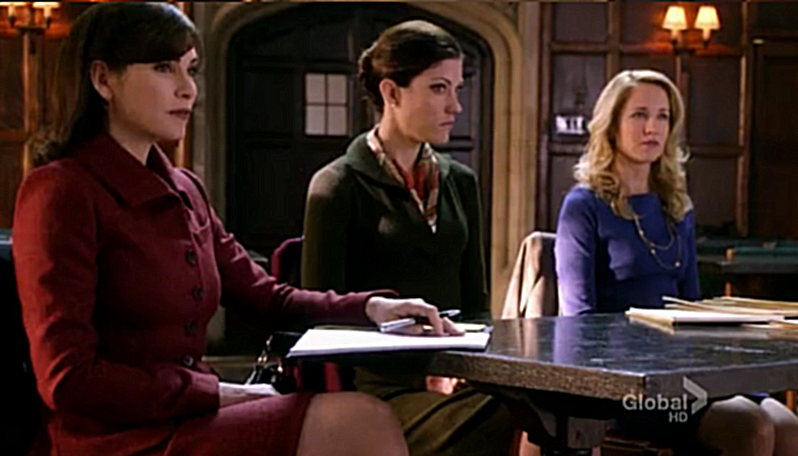
The Good Wife, as well as being very entertaining and probably the most grown-up show on television, contains some subtly excellent costuming. I haven't posted about it before because the clothes are just one aspect of a show that's brilliant overall, but like many aspects of TGW's quality they crept up on me.

This post requires a little backstory, but no major spoilers for the latest episode (3x10). Earlier in the season Alicia ( lawyer and titular "Good Wife") was told to hire a new junior, a choice narrowed down to two young women. Caitlin had a good resume but came across as a little frivolous, and Alicia clearly found it easier to relate to the more serious-minded Martha. However, Alicia was told to hire Caitlin anyway because she was the neice of one of the senior partners.

Because TGW is a show with three-dimensional adult characters, this didn't result in sulking or infighting. Although Caitlin wasn't Alicia's first choice, they've ended up with a good professional relationship, with Alicia even mentoring Caitlin to a certain extent. This week, though, showed the return of Martha, opposing them in court alongside Alicia's longtime rival, Michael J. Fox (!).

Wednesday, 23 November 2011

Leyendecker and the Arrow Collar Man.

Because I feel this blog has been tragically short on vintage suits so far, here's a post all about Leyendecker and the Arrow Collar Man.
The Arrow Collar Man is a creation of J.C. Leyendecker, a German-American illustrator of magazine covers and advertisements in the 1900s-30s. Leyendecker worked on a variety of illustrations and ad campaigns, but his speciality was these hyper-masculine, square-jawed all-American guys who spent their days smoking, posing in a manly fashion, and playing sports. The Arrow Collar Man is kind of The Man Your Man Could Smell like of the early 20th Century.